
Atmospheric Sunset Eclipse
Ancient cultures throughout time, like the Mayans and Celts, had a deep connection to the cosmos and fascinatingly astro engineered certain buildings to align with the sun and moon - helping predict eclipses! Additionally the Babylonians discovered the 18 year Saros cycle (time between eclipses) through precise record keeping and mathematics!
Which brings us to 2026 and that people in the 21st century are still drawn to watching solar and lunar eclipses!At 41.75204° N, 3.68044° W, on August 12th 2026, was our target location to photograph the center of the solar eclipse’s path and for the best view of totality in Spain!
This was the 2nd total solar eclipse in Spain since 1905. After traveling halfway around the world, spending a day and a half stranded in an airport, experiencing misplaced luggage and seat assignments we finally made it to Madrid! We then drove two hours North over the climbing Spanish Meseta to the college town of Valladolid.
The summit lasted 5 days and started at 7am with sessions to prep for the eclipse photoshoot including: timelapses, tele-zoom strategies, solar photography, and work flow editing. After lunch we headed to the Bodegas de Nabal Winery via bus. We drove through small towns with castles overlooking the arid landscape of grape vines and occasional trees. Moreover this was an eclipse part of the saros series that occurs every 18 years, 11 days and 8 hours - which is when the lunar phase closely matches the nodal and apsidal precession.
The Ribera del Duero River region on the Northern plains of the Spanish Meseta of Castille and Leon is on a high plateau reaching over 2,000 feet. The region is noted as a very hot and dry climate in the summer and bitterly cold in the winter! Temps for our practice on location were scorching hot with daily readings of 100F or above! Cameras had to be given breaks and covered with hotel towels to cool down and work again.On occasion we saw hikers with shells on their backpack walking the Camino de Santiago pilgrimage which crosses this region. We traveled by bus each way, 1.5 hours, to Bodegas Nabal winery to practice our setups for the moment of totality!
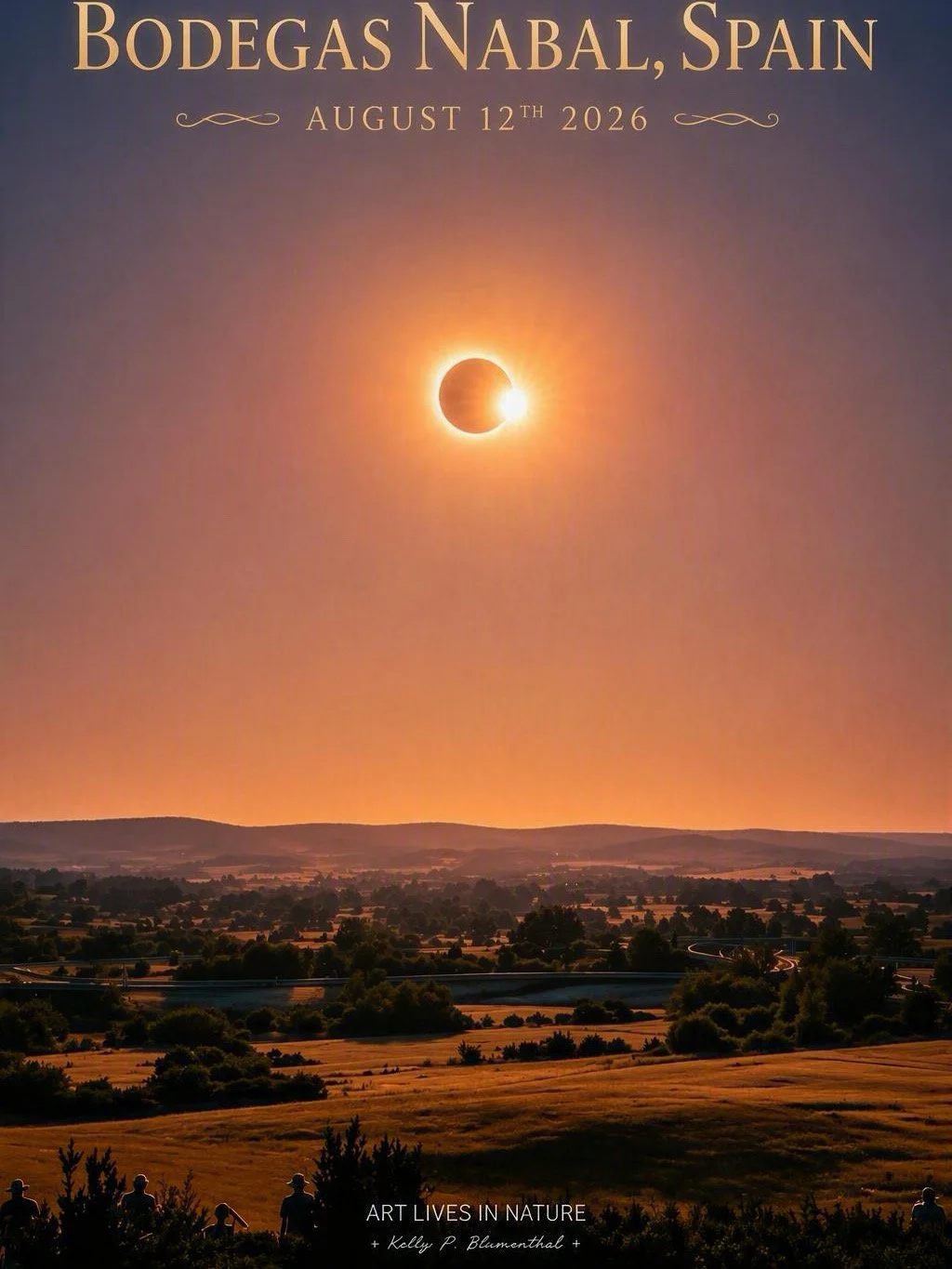
Setting up facing west before golden hour and sunset, we each had a four foot square area to practice in and focus on our subject…the Sun - the Star of our galaxy!
Practice Drills were called out by Dan Zafra of Capture the Atlas, our phenomenal workshop leader, “filters on…. filters off” within the short 60 seconds window! Specially designed solar eclipse filters block the intense rays of the sun from damaging your lens and camera.You can only removed the lens filter during totality, and with only 60 seconds we had to work quickly!
The group had lots of weather challenges leading up to the solar eclipse summit.Weeks before our location was surrounded with numerous and extreme wildfires and the poor air quality due to lingering smoke from the ongoing fires in Spain. Air Quality readings were often in the red zone!
There were also concerns over the “Clima”, often an issue in Spain from Saharan Dust blowing in from Africa’s Saharan Dessert, abated us all together! Thankfully and surprisingly all the elements came together just days before the eclipse!
The eclipse moves through several stages known as C1, C2, C3 and totality - where the moon is covering the sun!
C1 or first contact is the beginning of the eclipse when the moon starts to cover the sun, and its looks like a bite is taken out of the sun/moon shape!
C2 is an partially eclipsed sun nearly half covered and often noticeable atmospheric conditions occur with light and shadows!
C3 is the beginning of totality when the moon is going to cover the sun completely
C4 is after totality and the moon starts to shift back into place, uncovering the sun
We setup at the winery and were ready with our cameras hours before the eclipse stages started - then the light began to transition near C2 to twilight - the atmosphere changed dramatically and birds flew to their nests to roost for the night, while dogs barked in the background.The landscape suddenly filled with soft light in shades of blueish lavender and peach.
Two prominences appeared during totality one on the left and one on the right and a solar tornado on the very top. The prominence on the left was enormous, and it was remarkable to see such a vast and brightly colored neon red, undulating in the solar wind - this was unreal to see with the naked eye! The appearance of a sleepy landscape formed below the eclipse and long shadows appeared on the ground.The workshop leaders had emphasized that no matter what happens or what goes wrong, and it will, we were instructed to just shoot totality and most importantly stop and enjoy observing the total eclipse first hand. It is an experience of a lifetime - and just observing the light!
Since I had photographed the 2024 eclipse with a tele-zoom in Heber Springs, Arkansas - I planned out a landscape shot during totality, to capture the unique light and Spanish landscape! Using a prime 85mm lens, mounted on a solid tripod with a 3-way ball head for repositioning and tracking.Despite the shutter remote locking up during totality, I was able to go manual and press for rapid bursts for C3!!!
Astonishingly 80 photographers traveled from around the world to participate in the Total Solar Eclipse Photography Summit in Spain!!!
It was such a unique eclipse at sunset, so very low on the horizon at 8 degrees as it hung before you in the sky like a dazzling ornament and we watched an eclipsed it gradually sink, still eclipsed - below the horizon! Another bonus occurred during August, a lunar eclipse, which happened 16 days later and was a magnificent bookend to a stellar eclipse!